FPI Sector-Wise Investment August 2026: Consumer Services, Financials and Healthcare Lead Buying
Foreign portfolio investors (FPIs) returned to several Indian sectors during the second half of August 2026, but their buying was selective. NSDL data for August 16–31 shows that Consumer Services, Financial Services, Healthcare, Consumer Durables and Capital Goods attracted the strongest inflows, while Oil & Gas, FMCG, Telecom and Auto recorded net selling.
The data may indicate a rotation toward domestic consumption, financial growth and capital-expenditure themes. However, one fortnight of FPI activity should not be treated as proof of a lasting investment trend.
Key FPI Buying and Selling Sectors
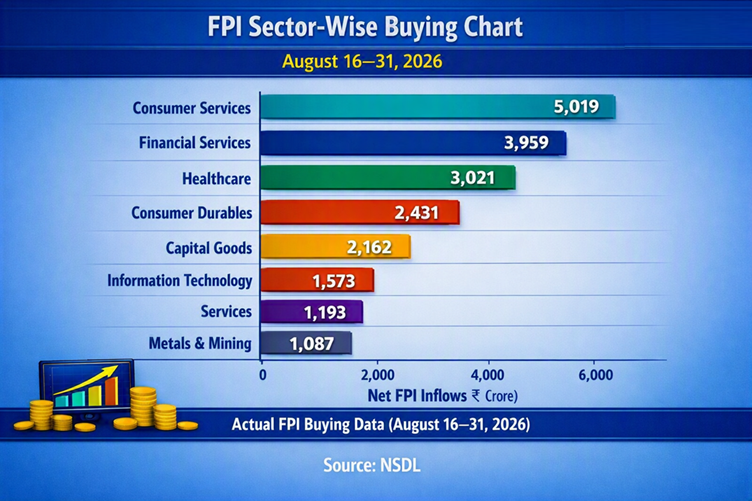
The figures represent sector-wise FPI activity during August 16–31, 2026, based on NSDL data. The ₹13,000-crore figure often cited for this period refers to equity-market buying during the second half of August and should not be confused with the full-month flow unless separately stated.
Consumer Services Leads FPI Buying
Consumer Services recorded the highest FPI buying during the fortnight, with net inflows of approximately ₹5,019 crore.
The buying may reflect foreign-investor interest in India’s expanding consumption economy. Rising incomes, urbanisation, premiumisation and increased spending on services could support the long-term growth outlook for companies in this segment.
However, sector-wise buying alone does not establish that FPIs are making long-term commitments. The activity could also reflect portfolio rotation, valuation changes, index adjustments, or changes in individual stock weights.
Financial Services and Healthcare Remain Strong
Financial Services attracted approximately ₹3,959 crore of FPI buying during August 16–31. The sector remains a major part of foreign-investor portfolios because of its connection with credit growth, formalisation of the economy and overall economic expansion.
Healthcare received around ₹3,021 crore of net FPI investment. The inflow may reflect interest in India’s pharmaceutical, healthcare-services and medical-consumption opportunities.
Both sectors have structural-growth characteristics, but investors should still evaluate individual companies based on earnings quality, valuations, asset quality, debt levels and cash flows.
Consumer Durables and Capital Goods Attract Buying
Consumer Durables received approximately ₹2,431 crore of FPI buying, while Capital Goods attracted around ₹2,162 crore.
The buying in Consumer Durables may be consistent with expectations of rising household consumption and greater penetration of electronics, appliances and other discretionary products.
Capital Goods, meanwhile, is linked to infrastructure spending, manufacturing expansion and private-sector capital expenditure. FPI buying in this segment could indicate interest in India’s investment cycle, although it may also reflect short-term sector rotation or stock-specific factors.
Oil & Gas, FMCG, Telecom and Auto See Selling
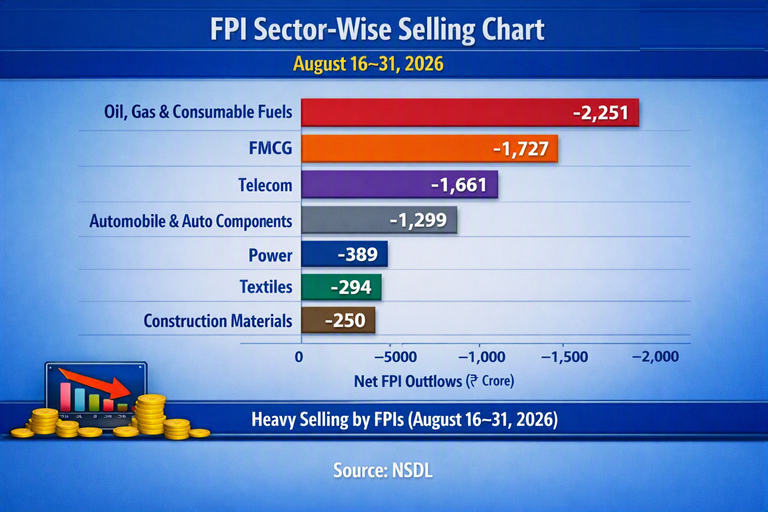
Oil, Gas & Consumable Fuels recorded the largest net FPI outflow during the fortnight, at approximately ₹2,251 crore.
The selling may reflect concerns related to crude-oil prices, margins, currency movements, or global risk positioning. Energy stocks can also be affected by geopolitical developments and changes in commodity prices.
FMCG recorded selling of approximately ₹1,727 crore. This contrasts with the buying seen in Consumer Services and Consumer Durables, suggesting that foreign investors may have been differentiating between defensive consumption companies and higher-growth discretionary segments.
Telecom saw net selling of around ₹1,661 crore, while Automobile & Auto Components recorded outflows of approximately ₹1,299 crore. These movements may have been influenced by valuations, earnings expectations, capital-expenditure requirements and stock-specific developments.
What Investors Should Understand
The latest FPI data offers three broad observations.
First, foreign buying was concentrated in sectors linked to domestic consumption, financial growth, healthcare and investment activity.
Second, the selling in Oil & Gas, FMCG, Telecom and Auto shows that FPI participation was selective rather than broad-based across all sectors.
Third, one fortnight of data should not be interpreted as confirmation of a permanent trend. FPI flows can change because of:
- Short-term valuation adjustments
- Index rebalancing
- Portfolio rotation
- Currency movements
- Global interest-rate expectations
- Changes in individual stock weights
- Global risk appetite
Therefore, FPI buying should be used as a market signal, not as a standalone investment decision.
Limitations of Sector-Wise FPI Data
Sector-wise FPI data shows where foreign investors were net buyers or sellers during a specific period. It does not reveal the complete reason behind those transactions.
The data does not necessarily prove that investors have a long-term view on a sector. It also does not identify whether buying was concentrated in a few large companies or spread across the entire sector.
Investors should combine FPI data with company fundamentals, earnings growth, valuations, balance-sheet strength, management quality, and broader economic conditions.
FPI flows should also be viewed alongside domestic institutional flows, mutual-fund activity, market breadth and global market trends.
Conclusion
NSDL’s fortnightly data for August 16–31, 2026 shows that FPIs were most active in Consumer Services, Financial Services, Healthcare, Consumer Durables and Capital Goods.
Consumer Services led buying with approximately ₹5,019 crore, followed by Financial Services at ₹3,959 crore and Healthcare at ₹3,021 crore. Consumer Durables and Capital Goods also attracted more than ₹2,000 crore each.
On the selling side, Oil, Gas & Consumable Fuels recorded the largest outflow at approximately ₹2,251 crore, followed by FMCG, Telecom and Automobile & Auto Components.
The overall pattern suggests a possible rotation toward domestic-growth and investment-linked sectors, while selected energy, defensive and cyclical segments faced selling. However, investors should avoid treating this single fortnight as proof of a sustained trend.
The next NSDL reports, corporate earnings, valuations, crude-oil prices, currency movements and global market conditions will help determine whether the August buying pattern continues.
Disclaimer
The information provided in this article is for educational and informational purposes only and should not be considered investment advice, financial advice, stock recommendations, or a recommendation to buy or sell any security.
The FPI figures and sector-wise investment data are based on information published by NSDL and other publicly available sources. While reasonable care has been taken to present the information accurately, FutureSense does not guarantee that all figures, interpretations or information are complete, accurate or up to date.
FPI buying or selling activity can change rapidly and may be influenced by portfolio rebalancing, valuations, index adjustments, currency movements, global market conditions and other factors. Past FPI activity does not guarantee future market or stock performance.
Readers should conduct their own research and consider their investment objectives, risk tolerance and financial situation before making any investment decision. Consult a SEBI-registered investment adviser or qualified financial professional before investing.
FutureSense and its authors are not responsible for any financial loss or damage arising from investment decisions made based on the information presented in this article.