India Festive Season 2026: How Ganesh Chaturthi to Christmas Could Boost Consumer Demand
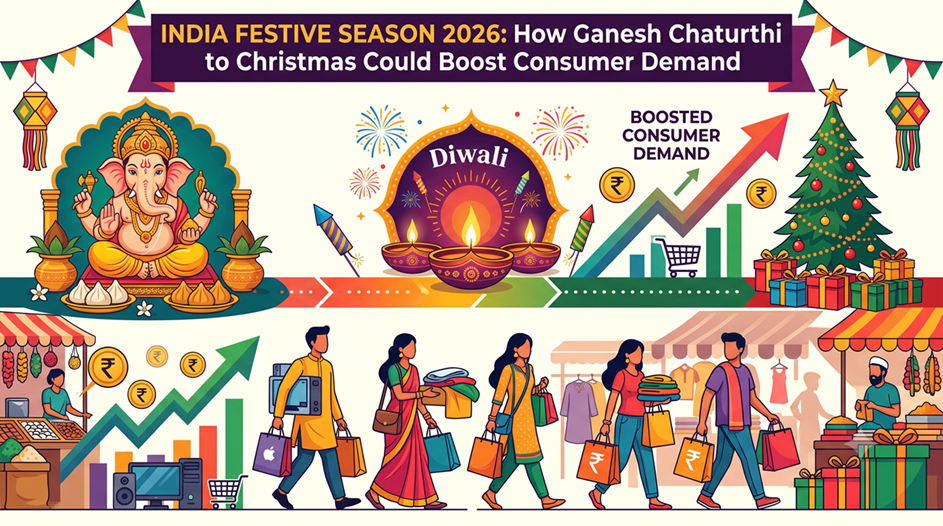
India is entering one of the most important consumption periods of the year. The festive season, beginning with Ganesh Chaturthi and extending through Navratri, Dussehra, Diwali, the wedding season, and Christmas, could provide a significant boost to consumer spending across several sectors.
For investors, the September-December period is particularly important because higher household spending can translate into stronger sales for automobiles, consumer durables, electronics, FMCG, jewellery, apparel, retail, travel, hotels and financial services.
The backdrop entering the 2026 festive season is also relatively strong. India’s economy grew 7.8% year-on-year in the April-June 2026 quarter, while consumer spending increased 7.1%, indicating that domestic demand remains an important growth driver.
Why the 2026 Festive Season Could Be Important
Festivals in India are not limited to religious celebrations. They are also an important period for household purchases.
Consumers typically bring forward purchases of:
- Cars and two-wheelers
- Smartphones and electronics
- Televisions and home appliances
- Gold and jewellery
- Clothing and footwear
- Furniture and home improvement products
- FMCG and packaged food
- Travel and hospitality
- Restaurants and entertainment
- Consumer finance products
This creates a seasonal increase in economic activity across the supply chain, from manufacturers and retailers to logistics companies, banks and digital-commerce platforms.
Ganesh Chaturthi Could Mark the Beginning of the Consumption Cycle
Ganesh Chaturthi is particularly important for Maharashtra and several other parts of India. It can provide an early boost to spending on food, sweets, decorations, consumer products, travel, restaurants and local retail.
The festival is also increasingly becoming an important period for brands to launch promotional campaigns and discounts.
However, the bigger consumption wave generally develops around Navratri, Dussehra and Diwali, when automobile, electronics, jewellery, apparel and other discretionary purchases tend to accelerate.
Automobile Demand Could Remain a Key Festive Theme
Automobiles are traditionally one of the most closely watched sectors during India’s festive season.
The early signs in 2026 have been encouraging. India’s passenger vehicle sales to dealers rose sharply in August, with total sales reported at 448,319 units, up 36% from the year-earlier period. Automakers have also increased dispatches to strengthen dealer inventories ahead of the festive season.
Maruti Suzuki reported a 21.3% year-on-year increase in total August sales, while Mahindra & Mahindra and Tata Motors also recorded strong annual growth.
If consumer sentiment remains strong, the festive period could support:
- Passenger vehicles
- SUVs
- Two-wheelers
- Commercial vehicles
- Auto components
- Vehicle financing
For investors, the automobile ecosystem could therefore remain an important festive-season theme.
Electronics and Consumer Durables Could See Strong Demand
Televisions, refrigerators, washing machines, air conditioners, smartphones and other electronic products are major festive purchases.
Recent industry commentary indicates that manufacturers are preparing for strong festive demand. Electronics contract manufacturers have reported significant increases in festive orders, while some appliance manufacturers have increased production to meet expected demand.
This could benefit the broader electronics manufacturing ecosystem, including:
- Electronics contract manufacturers
- Component suppliers
- Appliance manufacturers
- Mobile phone manufacturers
- Retailers
- E-commerce companies
- Logistics providers
The trend is particularly important for India’s electronics manufacturing sector, where increasing domestic demand is occurring alongside the country’s broader push toward local production.
FMCG Could Benefit From Higher Household Spending
FMCG is another major beneficiary of the festive season.
Festivals typically increase demand for:
- Sweets
- Snacks
- Beverages
- Packaged foods
- Personal-care products
- Household products
- Premium food products
Consumers may also trade up to premium brands during festivals, which can improve the product mix for companies.
Recent data suggests Indian households are increasingly allocating spending toward discretionary goods and services, indicating a broader shift toward premiumisation.
Jewellery and Gold Demand
Gold and jewellery remain deeply associated with India’s festive and wedding seasons.
Dhanteras and Diwali are particularly important periods for jewellery purchases, while the wedding calendar can extend demand beyond Diwali.
Jewellery companies could therefore benefit from increased footfall and higher transaction values.
However, investors should distinguish between higher gold prices and higher jewellery volumes. Extremely high gold prices can increase the value of sales while potentially affecting the quantity of gold purchased.
Therefore, jewellery companies should be evaluated based on both revenue growth and volume trends.
Apparel, Footwear and Lifestyle Spending
Festivals also generate substantial demand for clothing, footwear and lifestyle products.
Consumers often purchase new clothes for:
- Ganesh Chaturthi
- Navratri
- Dussehra
- Diwali
- Weddings
- Christmas and New Year celebrations
Organised retailers, fashion brands, department stores and online platforms could therefore experience increased traffic during the September-December period.
Travel, Hotels, Restaurants and Entertainment
The festive season is not only about physical products.
Travel, hotels, restaurants, cinemas, amusement parks and other entertainment businesses can also benefit from increased discretionary spending.
Families often combine festivals with holidays, while weddings and social events generate additional travel demand.
This creates a broader consumption multiplier involving:
Travel → Hotels → Restaurants → Transportation → Entertainment → Retail
Consequently, the festive season can support India’s services economy as well as goods consumption.
E-Commerce Could Capture a Larger Share of Festive Spending
Online shopping has become an integral part of India’s festive economy.
Consumers increasingly compare prices online before purchasing electronics, fashion, smartphones, home appliances, and other products.
Quick-commerce platforms are also expanding beyond traditional grocery delivery into additional consumer categories.
The 2025 festive season demonstrated the scale of India’s online opportunity, with one industry study estimating festive online sales could exceed ₹1.2 lakh crore.
The trend could continue in 2026 as consumers combine physical-store shopping with online purchases.
Rural Demand Could Be Another Important Factor
One of the biggest questions for the 2026 festive season will be whether consumption growth broadens beyond India’s major urban centres.
A strong rural economy can benefit:
- Two-wheelers
- FMCG
- Consumer durables
- Tractors
- Jewellery
- Apparel
- Agricultural equipment
A combination of improving rural incomes, agricultural performance and consumer confidence could therefore provide another layer of support to festive demand.
Banks and Consumer Finance Could Also Benefit
Festive purchases are increasingly financed through loans, credit cards, consumer durable financing and other forms of retail credit.
Higher automobile and consumer-durable sales can therefore indirectly benefit banks and non-banking financial companies.
The latest economic data also showed strong credit growth alongside India’s broader economic expansion.
Investors will therefore be watching retail-credit growth, credit-card spending, vehicle loans, and consumer finance during the festive period.
Which Stock Market Sectors Could Benefit?
The festive consumption cycle could create opportunities across several sectors.
1. Automobiles
Passenger vehicles and two-wheelers are among the biggest festive-season categories.
Watch: Maruti Suzuki, Mahindra & Mahindra, Tata Motors, Hyundai Motor India, and leading two-wheeler companies.
2. Consumer Electronics and Durables
Higher spending on smartphones, televisions, refrigerators, washing machines, and other appliances could support manufacturers and the electronics contract manufacturers.
Watch: Dixon Technologies, PG Electroplast and other companies exposed to electronics manufacturing and consumer appliances.
Recent industry commentary has already pointed to strong festive order growth in electronics manufacturing.
3. FMCG
Food, beverages, personal care and household products could see higher seasonal demand.
4. Jewellery
Gold and jewellery purchases can accelerate around Diwali, Dhanteras and the wedding season.
5. Retail and E-commerce
Organised retailers and digital-commerce companies are likely to compete aggressively for festive spending.
6. Banking and NBFCs
Consumer loans, vehicle finance, credit cards and other retail-credit products could receive a seasonal boost.
7. Hotels, Travel and Restaurants
Festive travel, weddings and family gatherings could support hospitality and leisure spending.
Why Investors Should Watch the December Quarter
The September-December period is particularly important because several major festivals fall within or around this period.
For many consumer-facing companies, the festive period can influence the performance of the October-December quarter, commonly referred to as the December quarter.
Investors should therefore watch:
- Volume growth
- Revenue growth
- Same-store sales
- Dealer inventory
- Rural demand
- Urban demand
- Promotional intensity
- Gross margins
- Consumer financing
- E-commerce sales
- Management commentary
Strong sales alone do not necessarily mean higher profits. Heavy discounts and promotional spending can increase volumes while putting pressure on margins.
Strong Demand Does Not Mean Every Consumer Stock Will Rise
This is an important point for investors.
A strong festive season does not automatically translate into higher stock prices.
Markets generally anticipate seasonal demand well in advance. A stock may already have a high valuation because investors expect strong festive sales.
Investors should therefore look beyond headline sales numbers and examine:
- Valuation
- Earnings growth
- Margin trends
- Market share
- Debt
- Cash flows
- Inventory levels
- Management guidance
Key Risks to Watch
The 2026 festive season also faces several potential risks.
Higher Commodity Prices
Higher crude oil and other commodity prices could increase transportation and manufacturing costs.
Inflation
If inflation rises, consumers may reduce discretionary spending.
Geopolitical Uncertainty
Global geopolitical developments could affect crude prices, inflation, and consumer confidence.
Excessive Discounts
Aggressive festive promotions can increase sales but reduce profitability.
High Valuations
Some consumer and retail stocks may already reflect optimistic earnings expectations.
2026 Festive Season: A Consumption Story to Watch
India’s festive season could become an important test of the strength of domestic consumption in the second half of 2026.
The starting conditions are encouraging. India’s economy expanded 7.8% in the April-June quarter, consumer spending remained strong, and automobile demand has shown momentum ahead of the festive period.
The festive cycle could therefore create a broad consumption wave extending from Ganesh Chaturthi to Navratri, Dussehra, Diwali, the wedding season and Christmas.
The biggest beneficiaries could include automobiles, electronics, FMCG, jewellery, retail, e-commerce, financial services, travel and hospitality.
For stock-market investors, however, the key question will not simply be “Will festive demand rise?”
The more important question will be:
“Which companies can convert higher festive demand into sustainable revenue growth, better margins and stronger earnings?”
That distinction could determine which consumer stocks actually benefit from India’s 2026 festive consumption cycle.
This article is for informational purposes only and should not be considered investment advice. Investors should conduct their own research and consider valuations, earnings, risks, and financial conditions before making investment decisions.