SEMICON India Mega Project: India’s Semiconductor Boom and Semiconductor Stocks to Watch
What was once largely a policy ambition is now moving toward commercial semiconductor production, packaging, testing, chip design, and a wider domestic supply chain.
The ongoing SEMICON India 2026, being held from September 17 to 19 in New Delhi, has brought India’s semiconductor ambitions into sharp focus. The event has brought together global semiconductor companies, Indian manufacturers, equipment suppliers, technology companies and policymakers.
The biggest development is the emergence of Semicon 2.0, which is intended to expand India’s semiconductor ecosystem beyond fabrication into equipment, materials, advanced packaging, design, R&D and talent development.
According to the Ministry of Electronics and Information Technology, around ₹1 lakh crore of investment commitments have emerged around the semiconductor ecosystem, with close to 1 lakh employment opportunities expected across the ecosystem.
For stock-market investors, the important question is:
Which listed Indian companies could participate in India’s semiconductor opportunity?
India’s Semiconductor Mega Opportunity
Semiconductors are the foundation of almost every modern technology industry.
They are used in:
- Smartphones
- Automobiles
- Electric vehicles
- Data centres
- Artificial intelligence
- Defence equipment
- Industrial automation
- Consumer electronics
- Telecom equipment
- Renewable energy systems
- Medical devices
India has historically been stronger in semiconductor design and engineering services than in semiconductor manufacturing.
The government’s current strategy is aimed at developing a much broader ecosystem.
This includes:
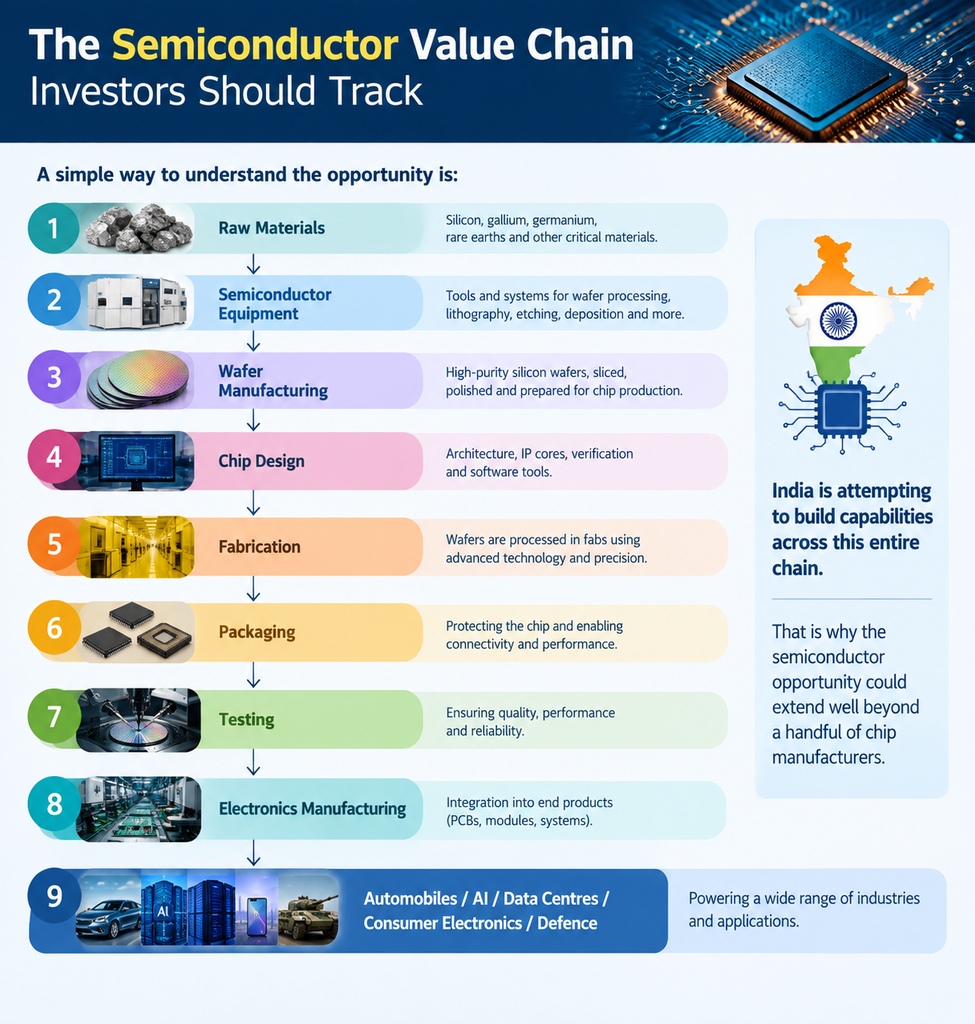
Chip design → semiconductor manufacturing → packaging → testing → equipment → materials → electronics manufacturing → end products
That makes the opportunity much larger than simply building a semiconductor fab.
SEMICON India 2026: A Major Turning Point
The fifth edition of SEMICON India is being held at Yashobhoomi, New Delhi.
The theme is:
“Silicon to Systems: Building the Ecosystem.”
The government has said that the semiconductor programme has moved from establishing the foundation toward building a complete ecosystem.
Prime Minister Narendra Modi inaugurated SEMICON India 2026 and highlighted India’s ambition to become a trusted semiconductor manufacturing destination.
The event is significant because global semiconductor companies are increasingly looking at India as part of their manufacturing and supply-chain diversification strategy.
Semicon 2.0: The Next Big Phase
Semicon 2.0 expands the scope of India’s semiconductor programme.
The focus is not only on semiconductor fabs.
The programme covers six broad areas:
- Semiconductor design
- Manufacturing
- Semiconductor equipment and materials
- Advanced packaging
- Research and development
- Talent development
The programme has been described as having a ₹1.27 lakh crore allocation, with the objective of developing capabilities across the semiconductor value chain.
This is important for investors because it creates opportunities for companies that may not manufacture chips themselves but can supply:
- Semiconductor equipment
- Electronic components
- Packaging solutions
- Testing services
- PCBs
- Materials
- Engineering services
- Chip-design services
India’s First Semiconductor Fab
One of the biggest projects is the Tata Electronics semiconductor fabrication facility at Dholera, Gujarat.
The government has notified the project as India’s first chip fabrication plant.
The project has a proposed investment of approximately ₹91,000 crore, according to the government’s April 2026 notification.
Tata Electronics has said that the Dholera fab is expected to manufacture chips in the 28nm to 110nm range, covering applications across several industries.
Tata Electronics is also developing a semiconductor assembly facility at Jagiroad, Assam.
The company has stated that its semiconductor projects in Gujarat and Assam involve a combined investment of approximately US$14 billion.
Important point for stock-market investors
Tata Electronics is not separately listed.
Therefore, investors looking at the Tata semiconductor story need to understand which listed Tata companies actually have direct or indirect exposure.
It is important not to treat every Tata Group company as a semiconductor stock.
Micron Semiconductor Project
Micron is developing a semiconductor assembly, testing, marking, and packaging facility at Sanand, Gujarat.
The government’s SEZ notification puts the proposed investment at approximately ₹13,000 crore.
Micron’s presence is significant because it brings a global memory-semiconductor manufacturer into India’s semiconductor ecosystem.
The project also creates opportunities for local suppliers, infrastructure companies, equipment providers, and electronics manufacturers.
CG Power: Semiconductor Packaging
CG Power & Industrial Solutions is one of the important listed companies in India’s semiconductor story.
Its semiconductor venture, CG Semi, has established an OSAT facility at Sanand, Gujarat.
Commercial production began in 2026, making it one of the early semiconductor facilities to move into commercial operations in India.
OSAT stands for:
Outsourced Semiconductor Assembly and Test.
In simple terms, semiconductor manufacturing does not end when a wafer is produced.
The semiconductor must be:
- Cut
- Packaged
- Tested
- Qualified
- Prepared for use in electronic products
OSAT is therefore an important part of the semiconductor value chain.
Why CG Power is important
CG Power provides investors with exposure to an established industrial company that is also developing semiconductor capabilities.
However, investors should distinguish between the company’s existing industrial/electrical business and its newer semiconductor business.
Kaynes Technology: OSAT + Electronics Manufacturing
Kaynes Technology India is another important listed company in India’s semiconductor ecosystem.
Its semiconductor subsidiary, Kaynes Semicon, has established an OSAT facility at Sanand.
Commercial production has started at the facility.
The company has also discussed further expansion under Semicon 2.0.
Recent reports indicate that Kaynes is considering a US$1 billion OSAT project under the second phase of India’s semiconductor programme.
This is significant because the company’s semiconductor opportunity could extend beyond its existing electronics manufacturing business.
What investors should monitor
For Kaynes, the important metrics include:
- OSAT production ramp-up
- Customer additions
- Capacity utilisation
- Semiconductor revenue
- Capex
- Margin contribution
- Technology partnerships
- New semiconductor projects
Syrma SGS: Electronics and Semiconductor Ecosystem
Syrma SGS Technology is another company attracting attention from investors during SEMICON India 2026.
The company operates in electronics manufacturing and related technology areas and is being associated with India’s growing semiconductor and electronics manufacturing ecosystem.
Its investor-relations disclosures show continuing investments and developments across its electronics manufacturing operations.
Syrma has also been among the semiconductor/electronics stocks that attracted market attention around SEMICON India 2026.
The important distinction is that Syrma should not simply be treated as a conventional semiconductor-fab company.
Its opportunity is more closely connected to the electronics manufacturing and semiconductor ecosystem.
Avalon Technologies: High-End Electronics Manufacturing
Avalon Technologies is another company that has come into focus as India’s electronics and semiconductor ecosystem expands.
Avalon operates in electronic manufacturing services and supports products across industrial, clean-energy, and other technology applications.
The company has recently attracted attention because of its exposure to high-growth electronics manufacturing areas.
SEMICON India has also brought Avalon into the semiconductor/electronics discussion, particularly around India’s expanding manufacturing ecosystem.
Investors should therefore distinguish between:
Direct chip manufacturing
and
electronics manufacturing connected to semiconductor demand.
Dixon Technologies: Electronics Manufacturing Play
Dixon Technologies is another listed company frequently discussed in India’s semiconductor and electronics manufacturing theme.
Dixon is primarily an electronics manufacturing company rather than a pure semiconductor manufacturer.
Its relevance comes from the broader localisation of electronics production in India.
As more semiconductor components are manufactured or packaged domestically, India’s electronics manufacturing ecosystem can potentially become deeper.
Dixon therefore represents a downstream electronics manufacturing exposure, rather than a pure-play semiconductor fab.
L&T: India’s Indigenous Chip Design Push
Another interesting development at SEMICON India 2026 came from L&T Semiconductor Technologies, a wholly owned subsidiary of Larsen & Toubro.
L&T Semiconductor Technologies unveiled 40 semiconductor products at SEMICON India 2026.
The company also showcased its first silicon-carbide product platform and an India-designed BLDC motor controller.
The semiconductor portfolio spans areas including:
- Analog and mixed-signal
- Compute
- Connectivity
- RF
- Power semiconductors
- AI-enabled applications
- Automotive applications
This is an important development because India’s semiconductor ambition is not restricted to manufacturing.
Chip design and intellectual property are equally important parts of the value chain.
HCLTech and the India Chip Project
The HCL-Foxconn joint venture is another major semiconductor development.
The project focuses on semiconductor manufacturing and is part of India’s effort to build a domestic chip ecosystem.
HCLTech is therefore relevant to the semiconductor theme, although its exposure is different from companies building OSAT facilities.
This illustrates why investors should classify semiconductor stocks by their position in the value chain instead of putting every technology company into one basket.
Semiconductor Stocks: Different Types of Exposure
There is no single category called a “semiconductor stock.”
Investors can divide the opportunity into several groups.
1. Semiconductor Manufacturing
Companies involved directly in semiconductor fabrication.
Example:
Tata Electronics
However, Tata Electronics itself is not separately listed.
2. OSAT / Semiconductor Packaging
Companies involved in assembly and testing.
Examples include:
CG Power
Kaynes Technology
This is currently one of the most visible areas of India’s semiconductor manufacturing progress.
3. Electronics Manufacturing
Companies manufacturing electronic systems and components that benefit from increasing localisation.
Examples include:
Dixon Technologies
Syrma SGS
Avalon Technologies
4. Semiconductor Design
Companies involved in chip design, engineering, and semiconductor IP.
Examples include:
L&T Semiconductor Technologies
and selected technology/design-service companies.
5. Semiconductor Equipment and Materials
This could become an important future segment.
As India builds fabs and packaging plants, facilities require:
- Manufacturing equipment
- Testing equipment
- Chemicals
- Gases
- Substrates
- Packaging materials
- Precision engineering
Semicon 2.0 specifically expands support toward these parts of the ecosystem.
Semiconductor Stocks to Watch
For investors building a semiconductor watchlist, the following listed companies can be studied:
CG Power & Industrial Solutions
Semiconductor OSAT exposure through CG Semi.
Kaynes Technology
OSAT plus electronics manufacturing exposure.
Syrma SGS Technology
Electronics manufacturing and semiconductor ecosystem exposure.
Dixon Technologies
Large-scale electronics manufacturing exposure.
Avalon Technologies
High-end electronics manufacturing exposure.
L&T
Indirect exposure through L&T Semiconductor Technologies.
HCLTech
Technology exposure through the HCL-Foxconn semiconductor initiative.
MosChip Technologies
Semiconductor design and engineering exposure.
ASM Technologies
Engineering and technology exposure related to semiconductor and high-tech industries.
Tata Elxsi
Engineering/design exposure rather than semiconductor manufacturing.
These companies are not equivalent semiconductor investments. Their business models, semiconductor exposure, financial profiles, and valuations are different.
Why Semiconductor Demand Could Grow
Several structural trends are increasing semiconductor demand.
Artificial Intelligence
AI requires enormous computing power.
That means increasing demand for:
- Processors
- Memory
- Networking chips
- Power semiconductors
- Data-centre infrastructure
Electric Vehicles
EVs use significantly more electronic systems than conventional vehicles.
This increases demand for:
- Power semiconductors
- Microcontrollers
- Sensors
- Battery-management chips
- SiC devices
Data Centres
India’s data-centre industry is expanding rapidly.
AI workloads are further increasing demand for:
- CPUs
- GPUs
- Memory
- Networking
- Power-management chips
Defence
Modern defence systems increasingly depend on:
- Radar
- Communications
- Electronic warfare
- Sensors
- Secure computing
This creates opportunities for domestic semiconductor and electronics capabilities.
India’s Semiconductor Opportunity Is Not Risk-Free
The semiconductor story is attractive, but investors should also understand the risks.
High Capital Expenditure
Semiconductor manufacturing requires enormous capital investment.
Projects can face:
- Construction delays
- Cost overruns
- Technology challenges
- Customer delays
Technology Risk
The semiconductor industry changes rapidly.
A technology that is competitive today can become less attractive as the industry moves to newer processes.
Customer Concentration
OSAT and semiconductor businesses may initially depend on a limited number of customers.
Loss of a major customer can materially affect capacity utilisation.
Valuation Risk
Semiconductor-related stocks can experience strong rallies when a major government announcement or industry event occurs.
That does not automatically mean earnings will rise at the same rate.
Investors should therefore compare:
Market Capitalisation
with
Current Revenue
Expected Semiconductor Revenue
Capex
Profitability
and
Cash Flow.
The Most Important Metric: Actual Revenue Contribution
One of the biggest mistakes in analysing semiconductor stocks is treating every company with a semiconductor connection as a pure semiconductor company.
For example:
A company may have:
₹5,000 crore electronics revenue
but only:
₹100 crore semiconductor-related revenue.
Its stock should not be analysed in the same way as a company whose majority of future growth comes from semiconductor manufacturing.
Therefore, investors should track the semiconductor contribution separately.
What to Watch After SEMICON India 2026
The real test begins after the event.
Investors should monitor:
- New semiconductor project approvals
- Actual capex deployment
- Construction progress
- Commercial production
- Customer agreements
- Capacity utilisation
- Semiconductor revenue
- Order books
- EBITDA margins
- Cash flows
- Debt
- Government incentives received
- New technology partnerships
- Export orders
The difference between an announcement and actual production can be very important for long-term investors.
India’s Semiconductor Story: From Policy to Production
India’s semiconductor journey has moved considerably beyond the initial policy stage.
The government says 12 projects were approved under the first phase, while commercial production has already started at multiple facilities.
The CG Semi OSAT facility is already in commercial production, while Kaynes has also commenced semiconductor production at its Sanand facility.
Meanwhile, Tata Electronics is building a major fabrication and packaging ecosystem, and global companies including Applied Materials and Lam Research are expanding their India presence.
Applied Materials announced plans to invest $5 billion in India over the next decade, while Lam Research has also announced a significant India manufacturing investment plan.
This indicates that India’s semiconductor opportunity is increasingly becoming an ecosystem story rather than a single-company story.
Final Takeaway
SEMICON India 2026 is an important milestone for India’s semiconductor industry.
The opportunity extends across:
Fabs + OSAT + Chip Design + Equipment + Materials + Electronics Manufacturing + AI + EVs + Data Centres.
For stock-market investors, the key is not simply to search for the “best semiconductor stock.”
Instead, understand where each company sits in the semiconductor value chain.
Companies such as CG Power and Kaynes Technology offer more direct exposure to semiconductor packaging and testing, while Syrma SGS, Dixon Technologies, and Avalon Technologies provide broader electronics-manufacturing exposure.
L&T and HCLTech represent different technology/design and semiconductor ecosystem routes, while MosChip and ASM Technologies provide additional semiconductor engineering exposure.
The next phase will be about execution.
Announcements, investment commitments and government support create the opportunity. Actual production, customer orders, utilisation, revenue and cash flow will determine how much economic value individual companies ultimately capture.
For investors, the semiconductor theme should therefore be treated as a long-term sector-analysis opportunity rather than a reason to buy a stock solely because its share price rises during SEMICON India.
This article is for educational and informational purposes only and is not investment advice. Investors should independently evaluate company financials, valuations, business exposure, and risks before making investment decisions.