When Interest Rates Rise: How RBI Rate Hikes Affect the Economy, Stocks and Your Life
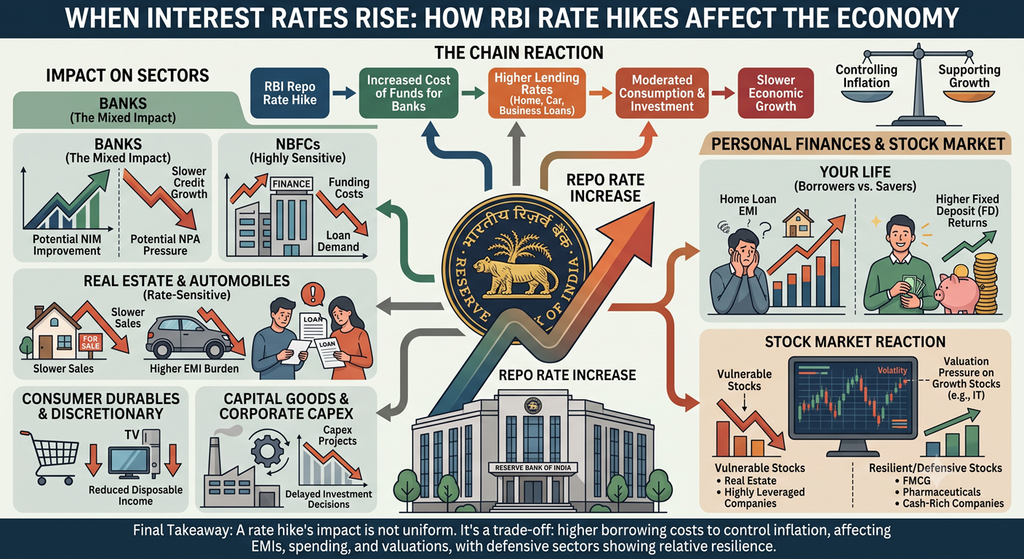
When the Reserve Bank of India (RBI) raises interest rates, the impact goes far beyond banks and borrowers. Higher rates can influence home-loan EMIs, car purchases, business investment, consumer spending, corporate earnings, stock-market valuations, and economic growth.
But a rate hike does not affect every sector in the same way.
Some businesses may benefit from higher rates or remain relatively resilient, while others can face pressure because they depend heavily on borrowing, consumer credit, or future growth.
Understanding this chain reaction is important for investors, businesses, and households.
What Happens When the RBI Raises Interest Rates?
The RBI uses monetary policy to influence financial conditions in the economy. One of the most important policy rates is the repo rate, the rate at which the RBI lends to banks against eligible securities.
When the repo rate increases, the cost of funds in the financial system can rise. Banks may subsequently increase lending rates, depending on the type of loan and the transmission mechanism.
The broad chain looks like this:
RBI rate hike → borrowing costs rise → loan demand may slow → consumption and investment moderate → corporate earnings can come under pressure → economic growth may slow.
At the same time, higher rates can benefit savers because deposit and fixed-income returns may become more attractive.
The effect is therefore a trade-off between controlling inflation and supporting economic growth.
Why Does the RBI Increase Interest Rates?
The RBI does not increase rates simply to make borrowing expensive.
One of the main reasons for monetary tightening is to control inflation.
If demand is growing too quickly or inflationary pressures remain persistent, higher interest rates can reduce excessive borrowing and spending.
The objective is broadly:
Control inflation → anchor inflation expectations → maintain financial stability → support sustainable long-term growth.
The RBI’s 2022–23 tightening cycle is a good example.
The repo rate was increased from 4% in May 2022 to 6.5% in February 2023, representing a cumulative increase of 250 basis points. RBI subsequently kept the repo rate at 6.5% while assessing the impact of the earlier increases.
Importantly, the RBI itself noted that monetary-policy changes take time to work through the economy.
This means investors should not expect every sector to react immediately.
Which Sectors Are Most Affected by Higher Interest Rates?
The impact can broadly be divided into three categories:
Potential beneficiaries or relatively resilient sectors
- Banks, depending on deposit and lending-rate dynamics
- Some financial companies with strong pricing power
- Insurance companies, depending on their investment portfolios and product mix
- FMCG
- Pharmaceuticals
- Healthcare
- Companies with strong cash flows and low debt
Mixed impact
- Banks
- Insurance
- Utilities
- Telecom
- IT
- Capital goods
Generally more vulnerable
- Real estate
- Highly leveraged companies
- NBFCs with high funding costs
- Automobiles
- Consumer durables
- Discretionary consumption
- Highly leveraged infrastructure companies
The important word is “generally.”
There are always company-specific exceptions.
1. Banks: A Mixed Impact, Not an Automatic Winner
Banks are often considered beneficiaries of rising interest rates, but the reality is more complicated.
Banks earn money primarily from the difference between the interest they receive on loans and the interest they pay on deposits and other funding sources.
This difference is known as the Net Interest Margin (NIM).
When lending rates increase faster than deposit costs, NIM can improve.
For example:
A bank may have:
- Average lending yield: 8%
- Cost of deposits: 4%
- Spread: 4%
If lending rates rise faster than deposit costs, the spread can temporarily improve.
However, there is a second side to the story.
If rates remain high for an extended period:
Higher EMIs → weaker loan demand → slower credit growth → borrower stress → potentially higher bad loans.
Therefore, a rate hike can initially support some banks but become less favorable if monetary tightening becomes prolonged.
What investors should watch
Instead of simply assuming that banks benefit, investors should monitor:
- Net Interest Margins
- Deposit growth
- Credit growth
- Cost of deposits
- Asset quality
- Gross and net NPAs
- Provisioning
- Loan growth in retail and corporate segments
Banking sector impact: Mixed.
2. NBFCs: Funding Costs Become Critical
NBFCs can be particularly sensitive to interest rates because many depend on external funding to finance their lending businesses.
When market borrowing costs increase:
Cost of funds ↑ → lending economics come under pressure
Some NBFCs may be able to pass higher costs to borrowers, but not all companies have the same pricing power.
Companies with:
- strong balance sheets
- diversified funding
- long-term liabilities
- high-quality borrowers
- strong collection efficiency
may be better positioned.
On the other hand, highly leveraged NBFCs with expensive funding can face significant pressure.
Gold-loan NBFCs
Gold-loan businesses can have different dynamics because lending is secured by collateral.
However, it would be incorrect to assume that gold-loan NBFCs automatically benefit from every rate hike. Their funding costs, competitive intensity, gold prices, loan growth, and asset quality also matter.
NBFC sector impact: Generally negative to mixed, depending on funding structure and pricing power.
3. Real Estate: One of the Most Rate-Sensitive Sectors
Real estate is among the sectors most directly affected by interest rates.
When mortgage rates rise:
Home-loan EMI ↑ → affordability ↓ → housing demand may slow.
Consider a hypothetical ₹50 lakh home loan.
Even a relatively small increase in the interest rate can increase the monthly EMI and reduce the amount a household can comfortably borrow.
This can affect:
- New home purchases
- Housing upgrades
- Affordable housing
- Residential launches
- Property transactions
Developers can also face higher financing costs.
Therefore, real estate companies with high debt can be more vulnerable.
However, the impact is not uniform.
Developers with:
- low debt
- strong cash flows
- strong pre-sales
- premium housing exposure
- low inventory
may be better positioned than highly leveraged companies.
Real estate sector impact: Generally negative.
4. Automobiles: Financing Costs Can Reduce Demand
Automobile demand is closely connected to financing.
A large number of consumers use loans to purchase cars, two-wheelers, and commercial vehicles.
When interest rates rise:
Vehicle loan cost ↑ → EMI ↑ → affordability ↓
The impact can be stronger in the mass-market segment, where consumers are more dependent on financing.
Potentially vulnerable segments include:
- Two-wheelers
- Entry-level cars
- Commercial vehicles
- Tractors
Premium vehicles may be relatively less sensitive because a larger proportion of buyers may have stronger financial capacity.
The impact can also spread through the supply chain.
Lower vehicle demand can affect:
OEMs → dealers → auto components → tyre companies → battery manufacturers → logistics → employment.
Auto sector impact: Generally negative, particularly for financing-sensitive segments.
5. Consumer Durables and Discretionary Spending
Higher interest rates can reduce disposable income for households with variable-rate loans.
If a family is paying more towards:
- Home loans
- Car loans
- Personal loans
less money may be available for discretionary spending.
This can affect purchases such as:
- TVs
- Refrigerators
- Washing machines
- Furniture
- Jewellery
- Dining out
- Holidays
- Entertainment
Companies selling essential products may be more resilient than businesses dependent on discretionary spending.
Consumer discretionary impact: Generally negative.
6. Capital Goods and Corporate Capex
Interest rates also influence corporate investment decisions.
Suppose a company is considering building a new manufacturing plant.
The project may require ₹1,000 crore of debt.
If financing costs rise substantially, the project’s expected return can decline.
Management may therefore decide to:
- delay the project
- reduce the investment
- phase the project
- use internal cash instead of borrowing
This can affect capital-goods companies over time.
However, India’s infrastructure and manufacturing investment cycle is also influenced by government spending, production incentives, export demand, and corporate balance sheets.
Therefore, higher rates do not automatically mean that India’s capex cycle will stop.
Capital goods impact: Mixed to negative, depending on the investment cycle and company leverage.
7. Infrastructure and Utilities: Don’t Assume Higher Rates Are Positive
Infrastructure is often considered a defensive sector, but that does not mean higher interest rates are automatically beneficial.
Many infrastructure projects require substantial upfront capital.
Higher borrowing costs can increase:
- interest expense
- project financing costs
- working-capital requirements
- refinancing costs
Companies with strong cash flows and long-term contracted revenues may be better positioned.
Highly leveraged companies can face greater pressure.
Utilities can also have relatively defensive demand, but their financial structure and regulatory framework matter.
Infrastructure/utilities impact: Mixed.
8. FMCG and Pharmaceuticals: Relatively Defensive
FMCG and pharmaceuticals are generally less sensitive to interest rates than real estate or automobiles.
Consumers may postpone buying a car or house when borrowing becomes expensive.
But demand for:
- food
- personal-care products
- household essentials
- medicines
does not usually disappear because interest rates increase.
That makes these sectors relatively defensive during economic slowdowns.
However, defensive does not mean guaranteed outperformance.
Stock valuations and company-specific earnings remain important.
FMCG/pharma impact: Relatively resilient.
9. IT and Technology Stocks: The Valuation Effect
Technology companies can be affected through a different channel.
Higher interest rates increase the discount rate used by investors to value future cash flows.
This can put pressure on high-growth stocks whose expected profits are far into the future.
For example, if investors previously valued a company based on strong earnings expected many years from now, higher interest rates can reduce the present value assigned to those future earnings.
This can cause:
Higher rates → higher discount rate → lower valuation multiples.
However, Indian IT services companies are also influenced by:
- US interest rates
- global technology spending
- recession risk
- currency movements
- client IT budgets
Therefore, the RBI’s rate decision alone does not determine the performance of IT stocks.
IT sector impact: Mixed; valuation can be affected, while earnings depend more heavily on global demand.
10. Highly Leveraged Companies Face the Biggest Risk
One of the most important factors investors should monitor during a rate-hike cycle is corporate debt.
Consider a hypothetical company with ₹500 crore of floating-rate debt.
At 6%, annual interest expense is approximately:
₹30 crore
If the effective borrowing cost rises to 8%:
Interest expense = ₹40 crore
The company now has an additional ₹10 crore annual interest burden.
That money has to come from somewhere.
It can mean:
- lower profit
- lower dividend
- reduced capex
- weaker cash flow
- additional borrowing
- asset sales
Therefore, investors should pay close attention to companies with high debt and floating-rate exposure.
How Higher Interest Rates Affect the Indian Economy
The economic impact generally works through several channels.
1. Consumption
Higher loan costs reduce disposable income for borrowers.
This can reduce spending on non-essential goods and services.
2. Investment
Businesses may delay projects when the cost of capital rises.
3. Housing
Higher mortgage rates can reduce affordability and housing demand.
4. Employment
If companies experience weaker demand, they may slow hiring or reduce investment.
The employment impact usually comes with a lag rather than immediately after a rate hike.
5. Inflation
Lower demand can eventually reduce inflationary pressure.
This is one of the primary reasons central banks tighten monetary policy.
6. Savings
Higher deposit and fixed-income rates can encourage households to save more.
This can reduce immediate consumption but increase financial savings.
Who Benefits From Higher Interest Rates?
The biggest potential beneficiaries are not simply “banks.”
The beneficiaries depend on the entire financial structure.
Potential beneficiaries include:
Savers
Higher interest rates can eventually translate into better returns on fixed deposits and other interest-bearing instruments.
Cash-rich companies
Companies with substantial cash balances can earn more interest income.
Low-debt businesses
Companies that do not depend heavily on borrowing are less exposed to higher financing costs.
Some financial institutions
Certain banks and financial companies may benefit if lending yields rise faster than funding costs.
Defensive businesses
Companies selling essential goods and services may be relatively resilient if economic growth slows.
Who Is Most Vulnerable?
Investors should pay particular attention to:
Highly leveraged companies
More debt means greater sensitivity to borrowing costs.
Real estate
Higher mortgage rates can reduce housing affordability.
Auto
Vehicle financing becomes more expensive.
Consumer discretionary
Households may reduce non-essential spending.
Highly leveraged infrastructure
Large debt requirements can increase interest costs.
Weak balance-sheet NBFCs
Funding costs can rise while loan demand and repayment capacity weaken.
How Does a Rate Hike Affect Your Personal Finances?
The impact on households depends heavily on whether you are a borrower or saver.
If you have a home loan
Your EMI may increase if your loan is linked to a floating benchmark and the lending rate is reset.
You may need to choose between:
- paying a higher EMI
- extending the loan tenure
- making a partial prepayment
If you are planning to buy a home
Higher rates can reduce your borrowing capacity.
However, it can also create opportunities if property prices or developer discounts become more attractive.
The right decision depends on your income stability, down payment, loan size, and long-term plans.
If you have a fixed deposit
A rising-rate environment can eventually provide opportunities to lock in higher deposit rates.
But investors should compare the available rates, tenure, taxation, and liquidity requirements before committing money.
If you have a personal loan or credit-card debt
Higher interest costs can become particularly expensive.
Reducing high-cost debt can be more important than chasing investment returns.
What Happens to the Stock Market?
The stock market often reacts before the economy does.
Investors continuously adjust expectations about:
- future interest rates
- inflation
- corporate earnings
- economic growth
- liquidity
- bond yields
A rate hike can therefore result in immediate market volatility even though the economic impact may take months to appear.
Stocks that can face valuation pressure
- High P/E stocks
- Long-duration growth companies
- Highly leveraged businesses
- Rate-sensitive consumer companies
- Real estate companies
- Certain NBFCs
Stocks that may show resilience
- Low-debt companies
- Cash-rich companies
- Defensive businesses
- Companies with pricing power
- Businesses with stable recurring cash flows
Again, these are broad tendencies, not investment recommendations.
The 2022–23 RBI Rate-Hike Cycle: What We Can Learn
India’s 2022–23 monetary tightening cycle provides an important historical reference.
The RBI raised the repo rate by 250 basis points between May 2022 and February 2023, taking it from 4% to 6.5%.
The RBI subsequently kept the repo rate at 6.5% while assessing the cumulative impact of previous rate increases. Its own analysis emphasized that monetary-policy transmission takes time.
This historical episode demonstrates an important lesson:
A rate hike does not instantly produce an economic slowdown.
There are transmission lags.
Loans need to reset.
Businesses need to change investment plans.
Consumers need to adjust their budgets.
Banks need to adjust deposit and lending rates.
Only after these changes work through the economy does the full impact become visible.
Therefore, investors should avoid simplistic predictions such as:
“RBI raises rates today, so the economy will collapse tomorrow.”
The real impact depends on the size and duration of the tightening cycle and the starting condition of the economy.
What Investors Should Track During a Rate-Hike Cycle
Instead of focusing only on the RBI announcement, investors should monitor several indicators.
Banking
- Credit growth
- Deposit growth
- NIM
- Cost of deposits
- NPAs
- Provisioning
Real Estate
- Housing sales
- New launches
- Inventory
- Mortgage rates
- Developer debt
Automobile
- Monthly registrations
- Vehicle financing
- Rural demand
- Tractor sales
- Dealer inventory
Corporate Sector
- Debt-to-equity
- Interest coverage ratio
- Interest expense
- Capex plans
- Free cash flow
Consumers
- Retail sales
- Consumer confidence
- Credit-card spending
- Consumer durable sales
Economy
- CPI inflation
- Core inflation
- GDP growth
- Industrial production
- Employment
- Bank credit
Rate Hikes Don’t Affect Every Company Equally
This is perhaps the most important lesson for investors.
Two companies can operate in the same sector but experience completely different outcomes.
Consider two infrastructure companies.
Company A
- Low debt
- Strong cash flows
- Long-term contracts
- High order visibility
Company B
- High debt
- Weak cash flow
- Large refinancing requirements
- Low interest coverage
If interest rates rise, Company B could experience significant financial pressure while Company A may remain relatively comfortable.
Therefore, sector analysis should always be combined with company-level balance-sheet analysis.
Rate Hikes: Good or Bad for the Economy?
The answer is both.
Short term
Higher rates can:
- increase borrowing costs
- reduce consumption
- slow investment
- pressure rate-sensitive sectors
- increase financial stress
Medium term
They can:
- reduce inflation
- stabilize inflation expectations
- encourage savings
- improve macroeconomic stability
- create room for sustainable long-term growth
The objective of monetary policy is therefore not to maximize growth at any cost.
It is to achieve a balance between inflation and sustainable economic growth.
What Should Investors Do?
Investors should not automatically sell everything when the RBI raises rates.
Instead, examine the exposure of individual companies to:
Debt + Interest Cost + Consumer Demand + Economic Growth + Valuation
A company with low debt and strong cash generation may withstand higher rates far better than a highly leveraged competitor.
Similarly, a bank with strong deposits and good asset quality may perform differently from a lender dependent on expensive wholesale funding.
The key is to understand how the rate cycle affects earnings, not simply whether the repo rate has increased.
Final Takeaway
Interest-rate hikes are one of the most powerful tools available to the RBI.
They affect almost every part of the economy, but the impact is neither immediate nor uniform.
Real estate, automobiles, consumer discretionary businesses, and highly leveraged companies generally face greater pressure when borrowing costs rise.
Banks can initially benefit in some circumstances, but prolonged high rates can eventually affect loan demand and asset quality.
FMCG, pharmaceuticals and other defensive businesses may prove relatively resilient because demand for essential products is less sensitive to interest rates.
For investors, the most important question is not simply:
“Will the RBI raise rates?”
The better questions are:
Why is the RBI raising rates?
How much will rates rise?
How long will rates remain high?
How quickly will lending rates increase?
Which companies have the strongest balance sheets?
And most importantly:
Are corporate earnings strong enough to absorb higher financing costs?
Understanding these questions can help investors identify potential risks before they appear in quarterly earnings.
Interest rates may look like a number announced by the RBI, but their effects eventually reach your EMI, your savings, your job, company profits, stock valuations, and the broader economy.
Disclaimer
This article is for educational and informational purposes only and should not be considered investment, financial, tax, or personal advice. Sector responses to interest-rate changes can vary depending on inflation, economic growth, liquidity, government policy, global interest rates, currency movements, and company-specific factors.
Past economic cycles do not guarantee similar outcomes in the future. Investors should conduct their own research and consult a qualified financial adviser before making investment decisions.