How to Think Like Smart Money in the Stock Market: 8 Things Traders Should Understand
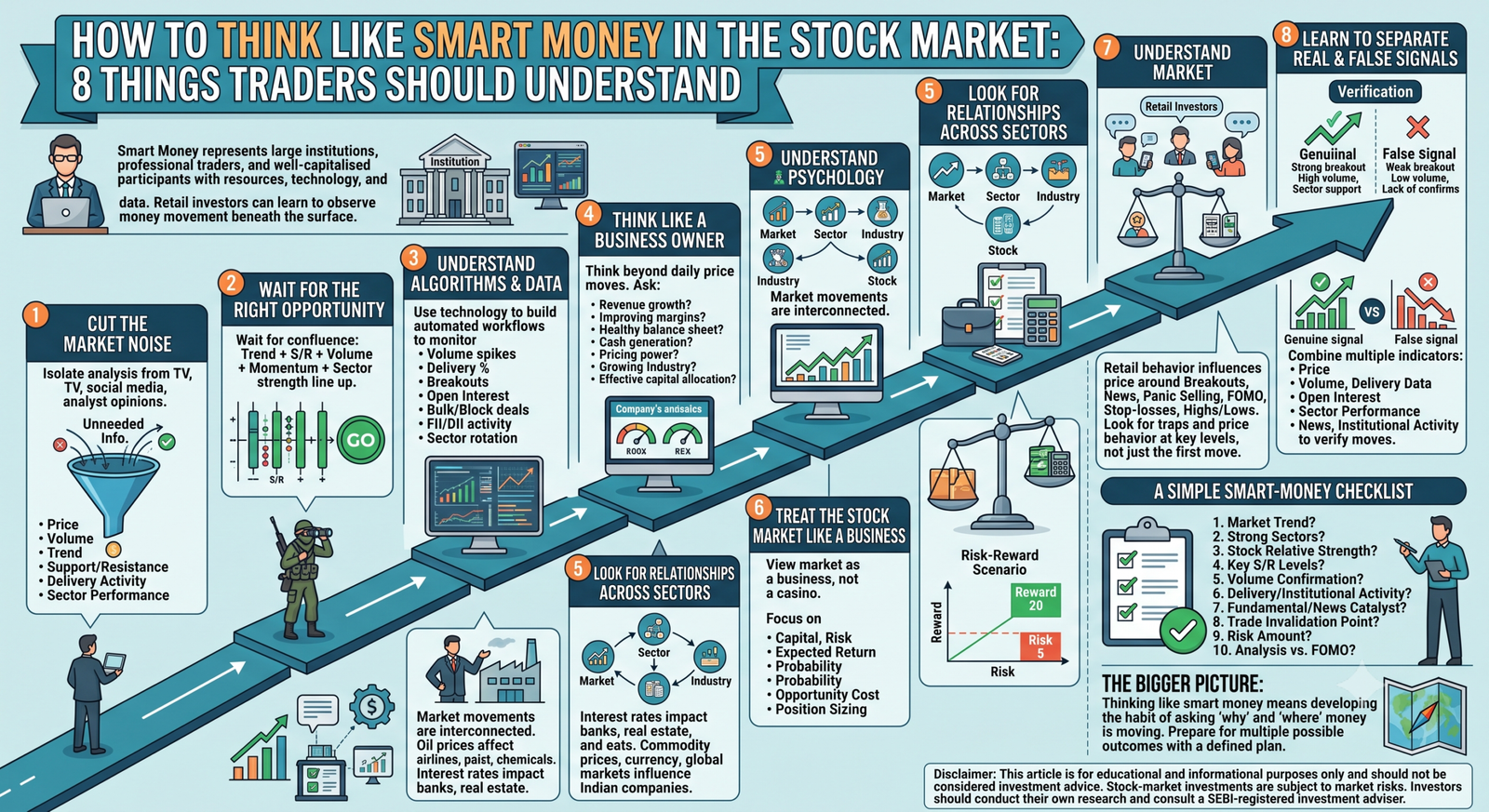
How to think like smart money? It is one of the most difficult questions for stock-market participants.
Large institutions, professional traders and other well-capitalised market participants have access to sophisticated research, technology, data and execution systems. Retail investors cannot always operate with the same resources, but they can learn to observe how money moves through the market.
The objective should not be to blindly follow every large trade. Instead, investors can study price, volume, sector behaviour, institutional activity, and market structure to understand what may be happening beneath the surface.
Here are eight principles that can help investors develop a more disciplined approach.
1. Cut the Market Noise
The first step is to isolate your analysis from unnecessary noise.
Stock-market participants are constantly exposed to television discussions, social-media posts, WhatsApp messages, analyst opinions, and short-term market predictions.
Too much information can sometimes make decision-making more difficult.
Before entering a trade, focus on the actual data:
- Price movement
- Volume
- Trend
- Support and resistance
- Delivery activity
- Sector performance
- Company-specific developments
- Institutional activity
The idea is to analyse the setup rather than trade based purely on somebody else’s opinion.
2. Wait for the Right Opportunity
There is no perfect setup in the stock market.
However, disciplined traders can wait for a setup where several factors line up.
For example, a trader may look for a combination of:
Trend + Support/Resistance + Volume + Momentum + Sector strength
When only one indicator gives a signal while the rest of the market structure disagrees, the trade may require greater caution.
Waiting is also a trading decision.
You do not need to participate in every market move.
3. Understand the Role of Algorithms and Data
Professional market participants increasingly use technology and algorithmic systems to analyse markets and execute trades.
A retail investor may not have access to the same infrastructure, but technology can still be used to improve the decision-making process.
For example, investors can build semi-automated workflows to monitor:
- Volume spikes
- Delivery percentage
- Price breakouts
- Open interest
- Bulk and block deals
- FII/DII activity
- Sector rotation
- Unusual price-volume activity
The objective is not to predict every market move.
Instead, data can help identify situations that deserve deeper analysis.
4. Think Like a Business Owner
A stock represents ownership in a business.
Therefore, a long-term investor should think beyond daily price movements.
Ask questions such as:
- Is the company’s revenue growing?
- Are margins improving?
- Is the balance sheet healthy?
- Is debt under control?
- Is the company generating cash?
- Does the company have pricing power?
- Is its industry growing?
- What is its order book or future growth pipeline?
- Is management allocating capital effectively?
This business-oriented approach can help separate company fundamentals from short-term market noise.
5. Look for Relationships Across Sectors
The stock market does not operate in isolation.
Different sectors can influence each other.
For example, movements in crude oil can affect airlines, paints, chemicals and other industries. Interest rates can influence banks, NBFCs, real estate and rate-sensitive sectors.
Similarly, changes in commodity prices, currency movements and global markets can influence Indian companies.
Therefore, instead of analysing one stock alone, look for relationships between:
Market → Sector → Industry → Stock
This broader view can sometimes provide additional context for a stock’s movement.
6. Treat the Stock Market Like a Business
One of the biggest differences between a disciplined investor and an emotional trader is the way they view the market.
The stock market should be treated like a business rather than a casino.
Every trade involves:
- Capital
- Risk
- Expected return
- Probability
- Opportunity cost
- Position sizing
Suppose a trade has a potential upside of ₹10 but a downside of ₹8. The trade needs to be evaluated differently from a setup where the potential upside is ₹20 against a possible loss of ₹5.
This is why risk management and position sizing are just as important as finding an entry point.
7. Try to Understand Market Psychology
Large market participants are also aware of how retail investors behave.
Retail investors often react to:
- Breakouts
- Sudden falls
- News headlines
- Panic selling
- FOMO
- Stop-loss levels
- Previous highs and lows
A sharp move in price does not automatically mean that the underlying trend has changed.
For example, a stock may briefly break a support level and then recover. Similarly, a breakout can fail if there is insufficient buying interest.
This is why traders should study price behaviour around important levels instead of reacting to the first move.
8. Learn to Separate Real and False Signals
One of the most important skills in trading is distinguishing between genuine market participation and temporary price movements.
A price breakout accompanied by strong volume and broader sector participation may provide a different signal from a breakout occurring on weak volume.
Similarly, a sudden price increase should be examined alongside:
- Volume
- Delivery data
- Open interest
- Sector performance
- Market trend
- Company news
- Institutional activity
No single indicator can tell you whether a trade is “real” or “fake”.
The more useful approach is to combine multiple pieces of evidence.
Smart Money Does Not Mean Guaranteed Profits
The phrase “smart money” can sometimes create the impression that institutional activity can be tracked perfectly.
That is not the case.
Large investors can also be wrong, and institutional buying or selling does not guarantee that a stock will rise or fall.
For retail investors, the more practical objective is to understand market structure and probability, rather than trying to copy every transaction made by large investors.
A Simple Smart-Money Checklist
Before taking a trade, investors can ask:
1. What is the overall market trend?
2. Which sectors are showing relative strength?
3. Is the stock stronger or weaker than its sector?
4. Where are the important support and resistance levels?
5. Is volume confirming the price movement?
6. Is there meaningful delivery or institutional activity?
7. Is there a fundamental or news catalyst?
8. What invalidates the trade?
9. How much capital am I willing to risk?
10. Am I entering because of analysis or because of FOMO?
If several answers do not support the trade, waiting can be better than forcing an entry.
The Bigger Picture
Thinking like smart money does not mean trying to predict the market.
It means developing the habit of asking why money may be moving, where it is moving, and whether multiple sources of data support the same conclusion.
For retail investors, the combination of fundamental analysis, technical analysis, volume and delivery data, sector analysis, and disciplined risk management can provide a structured framework for decision-making.
The real advantage is not knowing what the next market move will be.
It is being prepared for multiple possible outcomes and having a plan for each one.
Disclaimer: This article is for educational and informational purposes only and should not be considered investment advice. Stock-market investments are subject to market risks. Investors should conduct their own research and consult a SEBI-registered investment adviser before making investment decisions.